Going Forward
Why We Started
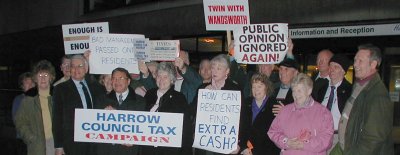
The Harrow Council Tax Campaign (HCTC) was founded in September 2002 by a group of Harrow residents who had simply had enough. Council tax bills had been rising year after year at rates far above inflation, while services appeared to be getting worse, not better. With the rallying cry of "Enough is Enough!" the campaign collected 25,000 signatures across the borough.
The immediate trigger was a proposed rise of over 20% in council tax for 2004, coming on top of a 20% rise the previous year. By that point, Harrow residents' bills had already doubled since 1997. The HCTC's position was straightforward: the council should limit tax rises to the rate of inflation, and stop wasting money on pointless projects.
The campaign was deliberately non-partisan. Its active members and supporters included Labour, Liberal Democrat and Conservative voters. This was about residents, not politics.
What We Were Up Against
Harrow's predicament was not entirely the council's fault — though that didn't make the bills any easier to pay. As we explained in our New Year statement for 2007, the council's income came from two sources: roughly a quarter from council tax itself, and the rest from the central government grant — in reality, our own tax money handed to Westminster and redistributed "according to need" by a formula of Byzantine complexity.
Harrow was getting the lowest government grant per head of population of any borough in London. Had we received the London average, it would have knocked around £860 per year off the average council tax bill. Our MPs were lobbied repeatedly. A council delegation went to Whitehall. Progress was slow.
Meanwhile, the Greater London Authority added its own precept on top of the council's element — and until 2004, that was uncapped entirely. Ken Livingstone's City Hall could, and did, raise its share as it pleased. The 2006 Olympics were cited by the GLA as justification for yet another surcharge, which the HCTC contested on the grounds that the Games were not being held in Harrow.
The campaign did have real effects. In April 2003, following the collection of 25,000 petition signatures, the rise — including the GLA precept — came in at less than 5%. The 2005 rise was a mere 0.72%. But these were battles won against a backdrop of structural pressures that no residents' campaign could permanently fix. The underlying problem — a council dependent on central grant that didn't reflect Harrow's needs, combined with no legal constraint on how much the council could raise — remained.
The Political Context After 2008
The financial crisis of 2008 changed the atmosphere dramatically. With household budgets under severe pressure and a climate of austerity taking hold, councils became politically inhibited from imposing the kind of inflation-busting rises that had characterised the early 2000s. Harrow, like many other authorities, exercised more restraint in the years immediately following the crash — not because of any new law, but because the political cost of large rises had risen sharply.
This was the environment into which the Conservative-Liberal Democrat coalition government arrived in May 2010. It moved quickly and in two distinct ways to entrench what post-crash political pressure had made temporarily true, and to give it permanent legal force.
Stage One: The Council Tax Freeze (2010)
Even before any legislation was enacted, the new Secretary of State for Communities and Local Government, Eric Pickles, used existing financial powers to incentivise councils to freeze their bills. The October 2010 Spending Review set aside £650 million in grant funding — paid under section 31 of the Local Government Act 2003 — to compensate English authorities that agreed to freeze council tax in 2011–12. Households in an average Band D property stood to save up to £70.
The freeze offer was renewed for successive years. Over the full five-year Parliament, the government provided a total of up to £5.2 billion in freeze grants, delivering a potential saving of up to £1,100 for a Band D household. In real terms, average council tax bills across England fell by around 10% between 2010 and 2015, a genuine reversal of the trend that had seen bills double under the previous administration.
This was the kind of outcome HCTC had been campaigning for throughout the 2000s. It arrived not through residents' pressure alone, but through a combination of post-crash political restraint and a government willing to put money behind its commitment to protect taxpayers.
Stage Two: The Localism Act 2011
The permanent structural protection came through the Localism Act 2011 (c.20), which received Royal Assent on 15 November 2011 and took effect from the 2012–13 financial year.
The Act replaced the old central government capping regime with a democratic mechanism rooted in local accountability. It did so by inserting a new Part 1A into the Local Government Finance Act 1992, with the key provisions at sections 52ZB and 52ZC, which created the concept of an "excessive" council tax increase and required a local referendum before any such increase could be implemented.
The mechanism works as follows:
Each year, the Secretary of State publishes a report setting out "referendum principles" (specific percentage thresholds) for each class of authority (county councils, unitary authorities, London boroughs, district councils, police and crime commissioners, fire and rescue authorities).
Every billing and precepting authority must determine whether its proposed increase would be "excessive" by reference to those principles.
Any authority wishing to exceed the threshold must: (a) hold a binding local referendum on its proposed increase; and (b) simultaneously prepare substitute calculations based on a non-excessive rate, which automatically takes effect if the referendum is rejected.
The referendum is decided by a simple majority. A "yes" vote allows the higher increase to proceed; a "no" vote means the lower substitute rate applies.
From 2016-17, a separate adult social care precept was added to the framework, allowing authorities with social care responsibilities to apply an additional percentage above the core threshold (initially 2% to reflect the specific funding pressures of an ageing population.
The coalition's stated rationale, set out in the Coalition Agreement itself, was explicit: to relinquish Whitehall's direct control over council tax and give that democratic power to local communities instead. As Pickles put it at the time: "If councils want to increase council tax further, they will have to prove the case to the electorate. Let the people decide."
This is precisely what HCTC had argued for throughout its existence. We did not have the power to legislate. We did have the power to demonstrate that residents, when given the chance, would say no to excessive rises, as our 25,000-signature petition showed.
What the Law Has Achieved
The practical effect of the Localism Act has been almost entirely deterrent in nature. Since 2012, only one referendum has ever been held under these provisions: in 2015, the Bedfordshire Police and Crime Commissioner proposed a 15.8% rise. When voters had their say on 7 May 2015, 69.5% rejected it. Surrey County Council contemplated a 15% increase for 2017–18 and thought better of it before even putting it to a vote.
In 2026–27, of the 384 authorities subject to referendum principles, not a single one set an increase above its permitted threshold. The mechanism operates, in effect, as an annually-set cap — with the referendum option present in law but almost never exercised, because councils know how such votes tend to go.
The current thresholds for 2026–27 are: up to 5% (including 2% for adult social care) for county and unitary authorities such as the London Borough of Harrow; 3% or £5 (whichever is higher) for shire district councils; £5 for fire and rescue authorities; and £15 for police and crime commissioners.
There are legitimate criticisms of the system. Financially struggling councils can apply to ministers for a bespoke, higher threshold — a backdoor that has allowed some authorities to secure increases well above the standard limit without holding a referendum. The Royal Borough of Windsor and Maidenhead, for example, secured approval for an 8.99% increase in 2025-26 through a one-authority exception created by the Secretary of State. Critics have argued this "hollows out" the democratic principle at the heart of the Act.
But compared to the world of 2002, when a Harrow administration could propose a 20% rise with no statutory constraint whatsoever, and residents' only recourse was to collect petition signatures and hope councillors were listening. The Localism Act represents a fundamental shift of power.
Why HCTC Still Exists
The Harrow Council Tax Campaign came into existence because there was no legal mechanism to stop a council raising council tax by whatever it chose, year after year. The Localism Act 2011 closed that particular gap; and that is a significant achievement, both for residents nationally and for the campaign that demonstrated, with 25,000 signatures, exactly how strongly Harrow felt about it.
But the job is not finished.
The legislative protection exists only as long as Parliament chooses to maintain it. Central government can change the rules at any time; raising thresholds, creating new exemptions, or quietly allowing ministers to grant one-authority exceptions that bypass the referendum requirement entirely. We will be watching.
There is also the long-standing question of how central government distributes our tax money back to local areas. Harrow has for many years received the lowest government grant per head of any London borough, subsidising areas elsewhere in the country through a redistribution formula that leaves Harrow residents paying hundreds of pounds more in council tax than they should. Advocates of this redistribution, such as Greater Manchester Mayor Andy Burnham, argue it is a fair way to balance wealth across regions. HCTC takes a different view: Harrow residents work hard, pay their taxes, and deserve a fair share of what comes back. That argument has not gone away.
And beyond the big legislative picture, there is the everyday business of holding Harrow Council to account for how it treats the people who pay its bills. For several years the council effectively switched off its telephone service, leaving residents, particularly older people without smartphones or internet access, unable to contact it at all. HCTC campaigned to restore telephone access, and that campaign was successful. It is a small example of a continuing need: someone has to be watching, and asking questions, and making noise when the answer isn't good enough.
We're still here. We're not sleeping, we're watching.
Last updated: 10-Jun-2026
Grant Campaign Takes Off
 HCTC is
delighted to join forces with the
Harrow Observer in the campaign for a sensible grant settlement from central
government. Our Council's spending money comes mainly from this grant, which is
made up of our tax money - but collected and 'redistributed' by Central
Government using an unbelievably convoluted formula. Needless to say, we're
losing out. We get around £300 less per head of population than the London
average. If we got our fair share our Council Tax bill would be cut
by hundreds of pounds and the Council would be able to fund services properly. HCTC is
delighted to join forces with the
Harrow Observer in the campaign for a sensible grant settlement from central
government. Our Council's spending money comes mainly from this grant, which is
made up of our tax money - but collected and 'redistributed' by Central
Government using an unbelievably convoluted formula. Needless to say, we're
losing out. We get around £300 less per head of population than the London
average. If we got our fair share our Council Tax bill would be cut
by hundreds of pounds and the Council would be able to fund services properly.
This situation has been in effect for years, but as more rules are handed
down by Central Government and a changing population profile in the borough it
has lead to the council tax payers to make up the increasing shortfall.
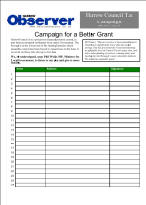
HCTC will be distributing a petition for everyone to sign. All our MPs and
councilors have signed already. This isn't a party-political issue. Everyone in
Harrow demands and deserves a fair deal.
You can download petition forms here
Watch this web site and the Harrow
Observer for more information. |








 As HCTC predicted, winning the Olympics is being
used as an excuse to raise Harrow's Council Tax yet again. The Olympics aren't
going to be in Harrow, so why should we be asked to pay when people outside
Greater London aren't asked to contribute. Whether you think the Olympics are a
good thing, or a commercial bonanza of no benefit to anyone other than the
sports industry, HCTC doesn't think it's fair for us to have to fund
it.
As HCTC predicted, winning the Olympics is being
used as an excuse to raise Harrow's Council Tax yet again. The Olympics aren't
going to be in Harrow, so why should we be asked to pay when people outside
Greater London aren't asked to contribute. Whether you think the Olympics are a
good thing, or a commercial bonanza of no benefit to anyone other than the
sports industry, HCTC doesn't think it's fair for us to have to fund
it.